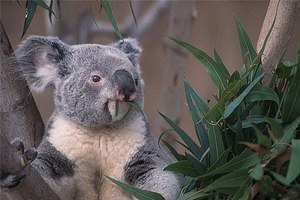
 Koalas are very ancient animals. They reached their diversification approximately 34-24 million years ago. According to archaeological data, up to 18 species were known at that time. The modern species most likely emerged 15 million years ago. There is a theory that tree kangaroos and koalas evolved from a common ancestor.
The first mention of this bear-like animal appeared at the end of the 18th century in Price J.'s report on his journey to the Blue Mountains.
- In 1802, the remains of the koala were sent for study by officer Barralier,
- In 1803, a living specimen of the species was captured. Newspapers subsequently published a description of it.
- In 1808 they were finally identified as a species similar to wombats.
Appearance
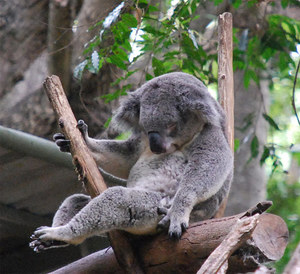 Koalas resemble wombats, but their fur is thicker and softer, reaching several centimeters in thickness. Their fur color can range from gray to tan, and even have a reddish tint, depending on the habitat. The fur on the belly is always lighter., than on the back. Large, furry ears and small brown eyes are set on the rather flat front of the muzzle. An adult can weigh up to 16 kilograms and stand 80 centimeters tall. The tail is very similar to that of a bear—short and almost invisible. Due to their appearance, they are often called marsupial bears.
Their long limbs are adapted for tree climbing. For example, the front paws have two opposable toes. All toes (except the thumbs) end in sharp claws, which aid in climbing trees. Furthermore, this arrangement of the toes on the front paws allows the young to cling tenaciously to the fur of adults. The hind paws also have one opposable toe.
One of the most interesting features of these animals is the presence of fingerprints on their toe pads. The papillary pattern is similar to that of humans.
The teeth are similar to those of kangaroos or wombats. Sharp and strong incisors, like other marsupial herbivores, are adapted for cutting leaves.
Furthermore, koalas have a pronounced binarity of genitalia. Females have two vaginas with two separate uteruses, while males have a bifurcated penis. This binarity is generally characteristic of all marsupials.
It's worth noting that the koala's brain has shrunk significantly over the course of its evolution. In modern koalas, the brain accounts for only a few tenths of a percent of their total mass. The free portion of the skull is filled with cerebrospinal fluid.
Lifestyle
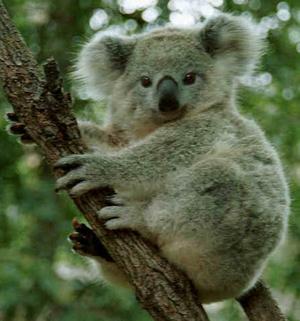 Koalas are very slow animals. They spend most of their lives in the canopies of eucalyptus trees. Almost no other animal sleeps as long as a koala. During the day animals are quite passiveEven when they're not sleeping, they sit motionless, clinging tightly to a tree with their claws. Thus, members of this species can spend up to 18 hours a day sleeping or completely motionless.
These animals are more active at night. Furthermore, if they can't reach a new tree, they descend to the ground very slowly and awkwardly. However, they are very agile tree jumpers and can easily climb trees if threatened. Koalas can also swim, although they only drink water during dry periods.
What do koalas eat?
Scientists have long agreed that the slowness of this species is related to their diet. These marsupials eat exclusively eucalyptus leaves and shootsInterestingly, at different times of the year, koalas choose the safest types of eucalyptus to reduce the risk of poisoning. Their highly developed sense of smell helps them navigate different types of eucalyptus.
Koalas consume up to 1 kilogram of leaves per day, which are finely chopped and stored as a grassy mass in pouches located behind their cheeks. They drink very rarely, obtaining all the moisture they need from the leaves.
How do koalas reproduce?
Female koalas typically live alone in their own home ranges, which they rarely leave. However, in fertile soils, home ranges may overlap. Males do not defend their territories, but when they meet they often fight, injuring each other. These marsupials gather in groups only during the breeding season, which begins in mid-autumn and lasts until the end of winter.
Fewer males are born in the wild than females. There are two to five females per adult male. To attract attention, males:
- leave scent marks on trees;
- make loud cries.
Mating occurs in trees. Like all marsupials, koalas have a very short pregnancy—about a month. Typically, a single cub is born, although twins are very rare. The cub is born very small and remains in the pouch for up to six months, nursing. For the next six months, the cub sits on its mother's back, clinging to her fur.
Females become independent at age from 12 to 18 months, and males can remain with their mothers for up to three years. This is because males and females reach sexual maturity at different times. Koalas reproduce infrequently: approximately once every two years.
Today, zoologists have a good idea of how long koalas live. In the wild, they live for approximately 13 years, although there are known long-lived koalas that have lived to be as old as 20.
Where do koalas live?
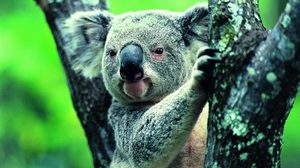 In the wild, koalas are found only in Australia. They can only be found in the southern or eastern parts of the continent. Kangaroo Island has been artificially populated with koalas. This cute and harmless animal can be found in other parts of the world. only in zoos or private nurseries.
While the koala population was virtually unregulated until the 19th century, and the only deaths were due to disease, drought, and fires, in the 19th century, after their discovery, they began to be hunted en masse. Koalas were hunted for their thick, highly prized fur. In 1927, due to the drastic decline in their numbers, the Australian government banned koala hunting.
A different situation has developed on Kangaroo Island, home to koalas that were artificially introduced there. In the 2000s, the burgeoning population of these marsupials led to the depletion of the eucalyptus forests, leading authorities to exterminate a large number of koalas, as they were at risk of starvation.