The Dogo Argentino is a large, powerful, and highly intelligent dog. In Argentina, it was used for hunting large game. The breed is unpopular in Russia. While the dog may appear dangerous and vicious, it has a gentle nature, is friendly with family members and children, and is devoted to them. If necessary, it can protect from danger.
Content
Historical data
The breed originated in the 20th century in Argentina. It was developed by brothers Antonio and Agustin Martinez. Fights involving Cordovan fighting dogs were popular in the country. Scientists were impressed by the strength, endurance, and power of these animals. They wanted to create a new breed with ideal appearance, a docile nature, and one adapted to family life. The Cordovan dog, boxer, pointer, bull terrier, Great Dane, and other breeds were used in the experiments. In 1973, the breed was recognized internationally.
The Dogo Argentino is the symbol of the country. It is also known as the "Dogo Argentino," the Argentine Mastiff, or the "White Angel of Death." It is the first and only breed developed in Argentina.
External description
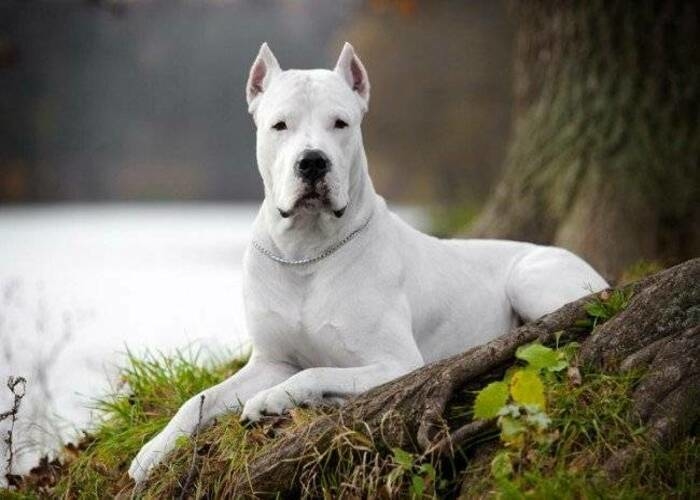
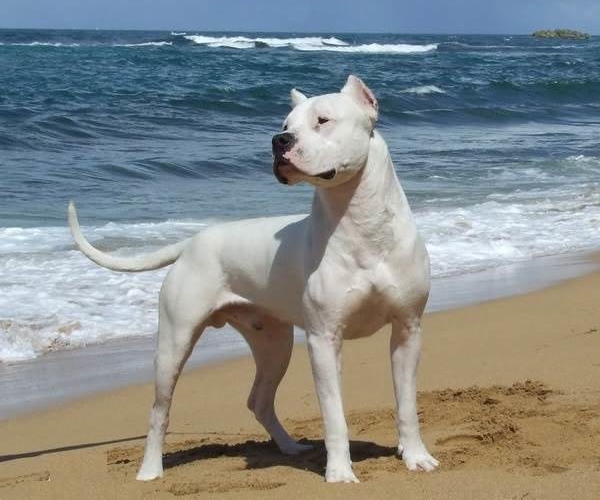
Life expectancy is 12–16 years. These are large specimens, with a shoulder height of 60–68 cm for males (weight 40–45 kg) and 60–65 cm for females (weight 40–43 kg). Males are always noticeably larger and more massive. Following global recognition, standards were defined:
- The skeleton is strong, the bones broad. The build is proportional, muscular, and athletic. The body is square. The withers are clearly defined. The chest is broad and deep. The abdomen is tucked up. The legs are long, with well-developed muscles. The tail is long, thick at the base, gradually tapering toward the tip. When at rest, it hangs down.
- The neck is strong, short, and well developed. There are two small folds under the throat.
- The head is large, without sharp angles or abrupt transitions. The forehead is wide. The parietal muscles are prominent. The stop from the forehead to the muzzle is slightly defined.
- The muzzle is square, proportionate to the length of the skull. The nose is large, slightly upturned, and black with large nostrils. The cheekbones are clearly visible.
- The jaws are strong and powerful. The lips are black. The teeth are white. The canines are large and sharp. The bite is pincer- or scissor-like. The incisors are positioned strictly in a straight line. The bite can cause serious damage to soft tissue.
- The ears are set wide and high. When cropped, they are erect and pointed. Uncropped, they are semi-erect, wide at the base and rounded at the tips, hanging down to the sides of the head. Cropping is at the owner's discretion; in many European countries, it is prohibited.
- The eyes are almond-shaped, small in size, set wide and obliquely, brown or black, framed by a dark eyelid.
The coat is short, straight, lies close to the body, and is harsh and shiny. There is no undercoat. The skin is elastic and thick, with dark pigmentation permitted. The coat is white, but may have a spot on the muzzle (usually around the eye), covering no more than 10% of the base color.
Personality traits
This dog is loyal, active, cheerful, and good-natured. It has a balanced character, is highly intelligent, and is not prone to aggression. It only barks when necessary. It is suitable for families with children (it is not jealous).
Great Danes were originally used for hunting. They have quick reflexes and swift movements. They are alert, courageous, strong, and resilient, ready to help and protect. They are useful as guard dogs for homes and territories. They can participate in search and rescue operations and serve as guide dogs for the blind.
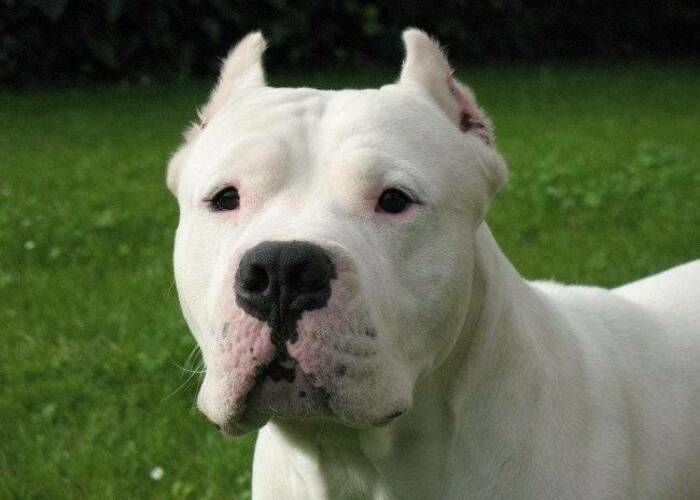
The Dogo Argentino has never been used for dog fighting.
These dogs are trainable. It's important to establish boundaries from an early age (showing that humans are in charge). Every command must be obeyed correctly. Allowing the dog to dominate is not acceptable. Harsh behavior, such as yelling, hitting, or deprivation of food, is unacceptable.
Pets need to be socialized from an early age (trained to react appropriately to passersby and cars). Great Danes do not get along well with other pets and are territorial. However, if pets are raised with them, problems will not arise. Dogs require regular exercise and are capable of being dominant. If the owner lacks experience with this breed, it is best to consult a dog trainer. Great Danes do not tolerate prolonged periods of loneliness well. Out of boredom, they may chew furniture and shoes.
Choosing a puppy
The breed is not widespread in Russia, but prestigious nurseries can be found in large cities.
A puppy is offered for sale at 2-2.5 months. By this age, it should have all the necessary vaccinations and a veterinary passport. A healthy puppy is well-fed, strong, active, and playful, with a beautiful, soft coat, a moist nose, and bright eyes.
It's important to observe the behavior of your chosen pet in its natural environment. Ask the breeder for documentation of its parents' pedigree to verify its lineage and health.
The price of a pet-class puppy (for family use) is 15,000–20,000 rubles. Elite specimens for breeding and shows cost 30,000–50,000 rubles.
A dog is given a name. Sometimes it's given at the kennel. It can be kept or changed. Popular names for girls: Elsa, Rona, Ruta, Sherry, Utah, Emma. For boys: Ron, Rich, Ted, Archie, Lord, Zeus, Sam, Pete.
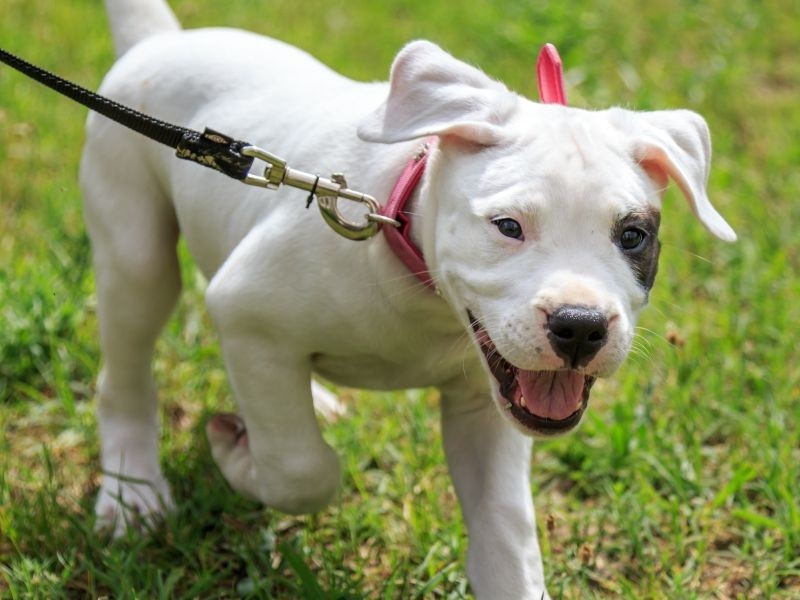
Maintenance and care
The Dogo Argentino is an easy-to-care-for dog. A country house with a spacious yard for walks is ideal. If this isn't possible, the pet can adapt to apartment life.
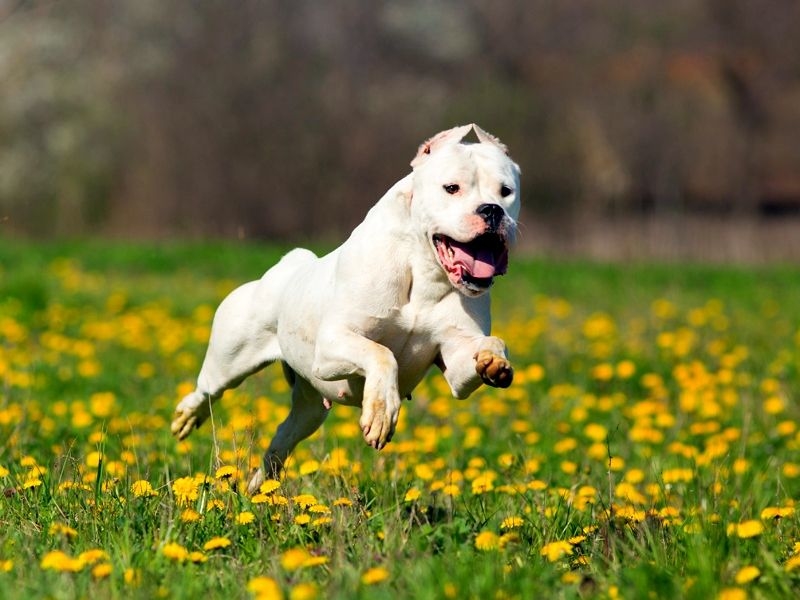
Dogs require regular exercise (running, jumping obstacles, swimming, active play, and long walks). Walk them twice a day for 1.5-2 hours. In public areas, use a leash and muzzle. You can take your pet outdoors: to the forest, to the river, or on a hike.
The dog is not suitable for being kept on a chain and winters indoors. In summer it can be kept in an enclosure protected from drafts and rain.
A warm, quiet place with a bed and toys is set up in the house. A bowl and grooming products (shampoo, combs, and nail clippers) are purchased.
Care
No special care is required. The owner performs standard procedures. The puppy is accustomed to these from puppyhood:
- Brush the fur once every two weeks using a special rubber glove.
- Teeth are brushed weekly. To remove dark plaque, special edible sticks are purchased.
- The claws are trimmed once a month and cut short.
- Don't overdo it with bathing. It's recommended to bathe short-haired dogs 3-4 times a year. Use a special shampoo.
- Wipe the eyes with a damp cloth once a week, and clean the ears with a cotton swab. Special cleansing drops can be used.
Proper nutrition
A natural diet should be created or a premium or super-premium commercial food should be used. The basis of the diet is raw meat (chicken, turkey, rabbit, beef), cooked organ meats, and fish.
You can give rice, oatmeal, corn, buckwheat, and small vermicelli porridge. Mix in some vegetables, herbs, and vegetable oil.
Fermented milk products are given daily (kefir, cottage cheese, milk, fermented baked milk, whey, unleavened cheeses, plain yogurt). Once a week, 2-3 boiled chicken eggs are given.
Food from the owner's table is unsuitable: smoked, salted, fried, fatty, pickled, spicy, savory, and baked foods are all off-limits. These foods negatively affect the dog's sense of smell. Legumes, boiled potatoes, fresh cabbage, and tubular bones should be avoided. All of these are poorly digested.
Puppies have a good appetite, but you shouldn't overfeed them. Until 6 months, babies are fed 4-5 times a day in small portions. After that, they are transitioned to two meals a day. The feeding amount is gradually reduced.
Health problems, diseases
The dog is strong and hardy, but improper nutrition and care can cause some serious diseases:
- Food allergies. Redness and a rash appear. It's important to identify and eliminate the offending foods.
- Joint problems in the limbs. These occur in old age or with obesity and are not treatable. The pet experiences difficulty moving and limps.
- Vision problems. Appear with age.
- Colds due to frequent bathing and exposure to cold and drafts.
An animal can be deaf from birth. This condition typically manifests in individuals with breed-specific defects, such as spotted coats and light-colored eyes.
Regular veterinary checkups are essential (at least twice a year). Vaccinations (distemper, hepatitis, rabies) should be administered annually, and deworming should be performed.
Breeding
Only healthy individuals with ideal breed characteristics are allowed to breed. The optimal age for mating is 2 years (after the female's third heat).
By this time, the animal's body is fully formed.
Knitting
A partner is selected in advance. It is also necessary to administer helminth (worm) prophylaxis. The meeting takes place on the male's territory.
Pregnancy lasts an average of 60 days. During this period, the dog is given rest, and several veterinary checkups are important. The mother usually experiences no problems carrying the pregnancy. The birth is easy, but supervision is a good idea. Litters range from 6 to 12 puppies. It is recommended to breed the female no more than once a year.
Caring for offspring
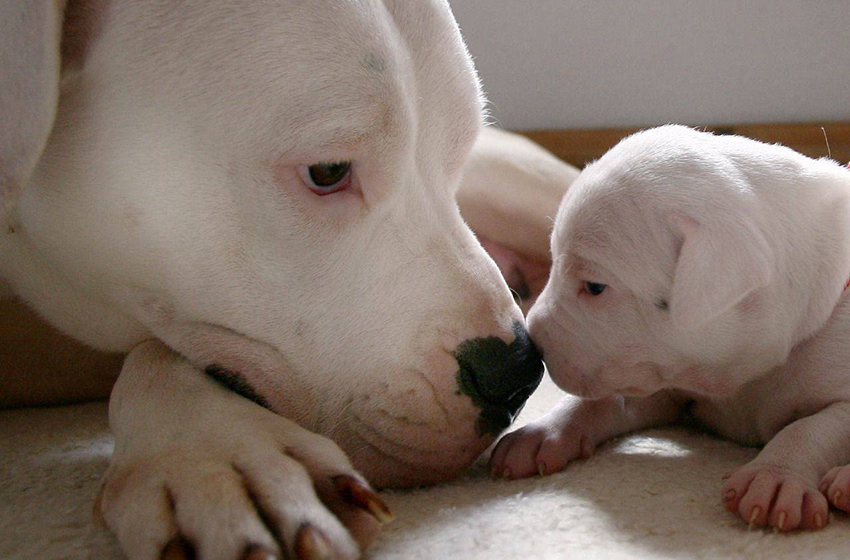
The mother takes good care of her children, feeding them breast milk. This provides them with all the necessary vitamins and minerals.
Puppies grow and develop quickly. At 2-2.5 months, they become independent. They receive the necessary vaccinations and are prepared for sale. It is recommended to choose a new home early.
The Dogo Argentino is a versatile dog, suitable for guarding, hunting, and making an excellent companion. These dogs are intelligent, friendly, obedient, and active when properly trained.