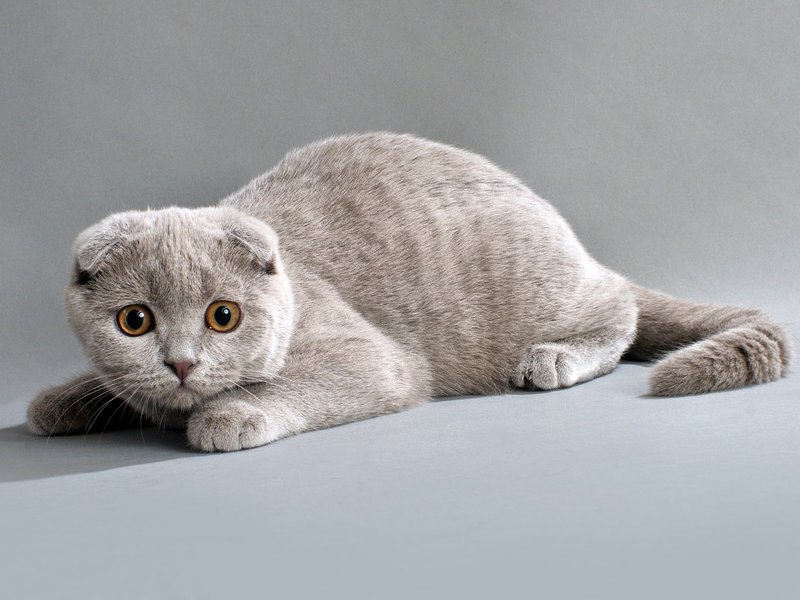
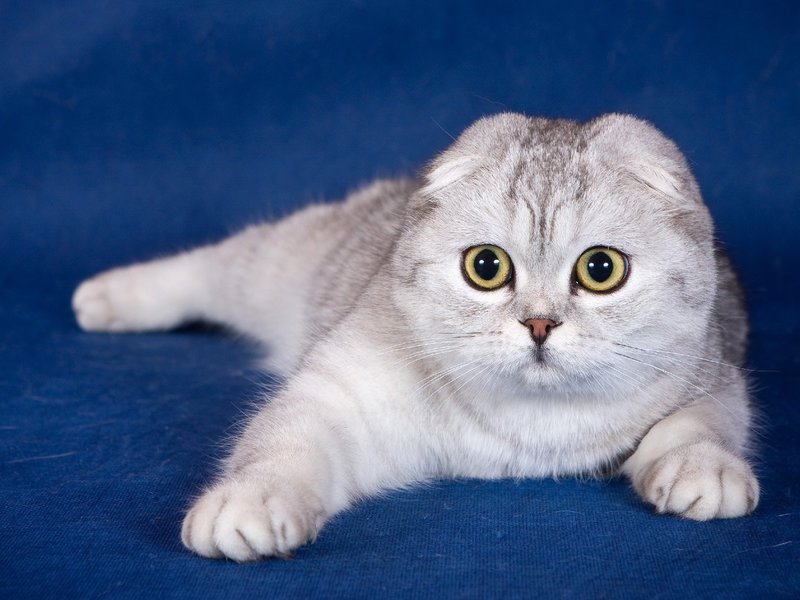
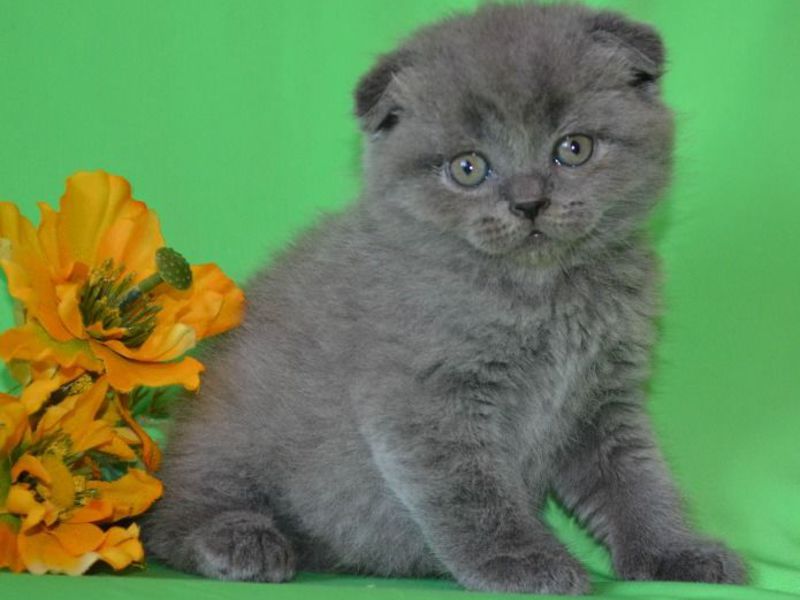
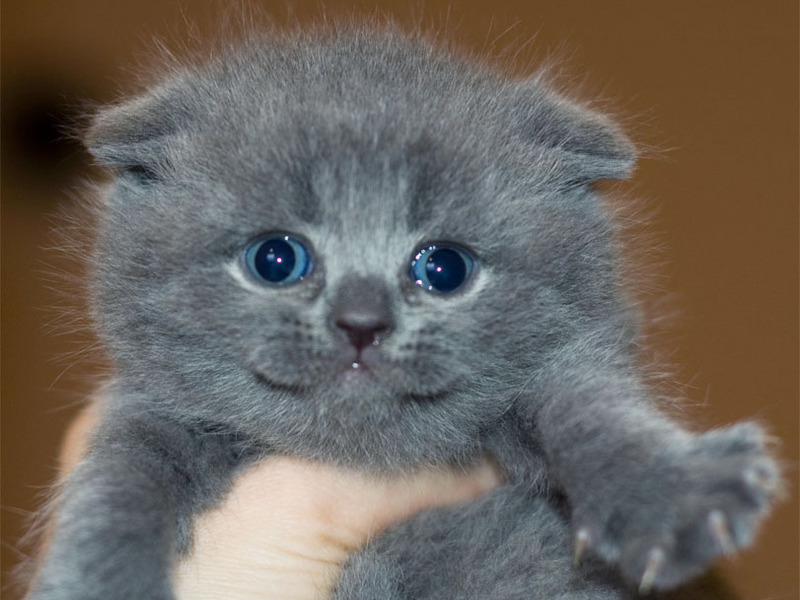
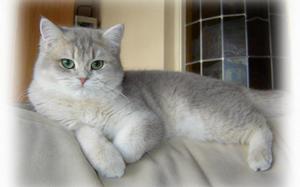
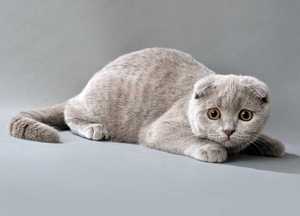
 Scottish Fold cats have already gained immense popularity throughout the world and are considered a fairly common breed of domestic cats.
They have a beautiful, strong body and a broad chest. However, Scottish Fold males are smaller than their British counterparts. Females weigh on average 3.5 to 4 kg, and males 4 to 6 kg.
Content
Breed characteristics
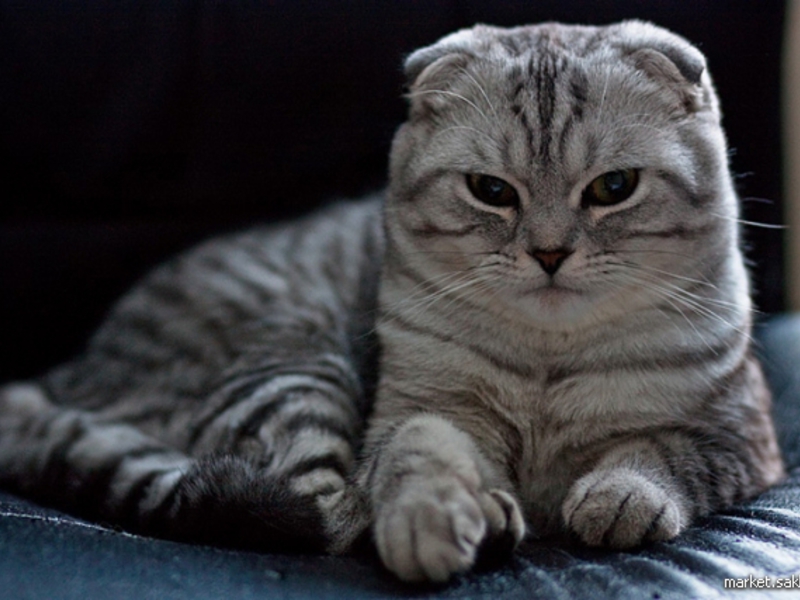
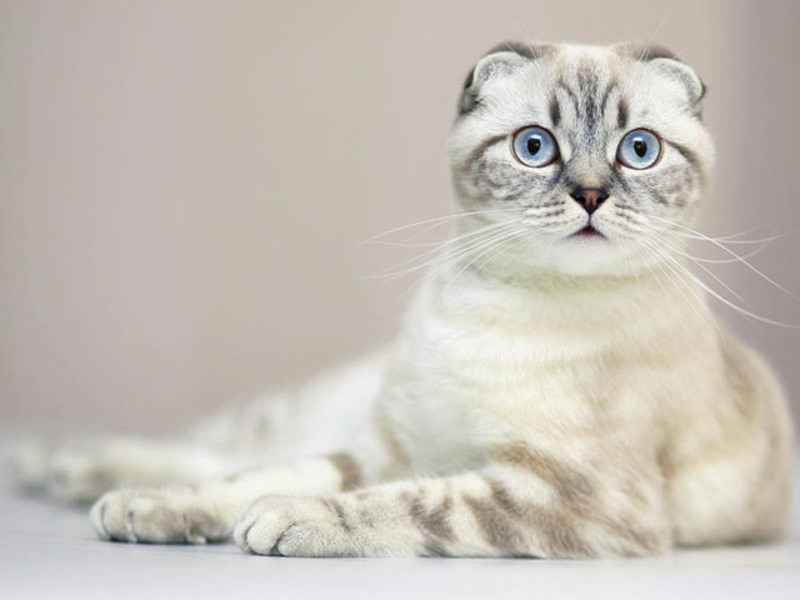
The head is typically round, with a slightly protruding jaw. Distinguishing features of this breed include prominent cheeks and distinct whisker pads. These features are clearly visible in the photo below.
The neck is thick and short, the nose should also be short and with a small hump.
A specific eye color is not assigned to a breed, but depends on the coat color. The eyes are round.
Particular attention should be paid to the paws of Scottish Fold cats—they are small and rounded. However, the hind legs are often thicker, which can interfere with normal movement and cause some discomfort for their owners.
The fur should be thick and elastic, but no specific color is typical for these cats.
Determining the degree of lop-earedness
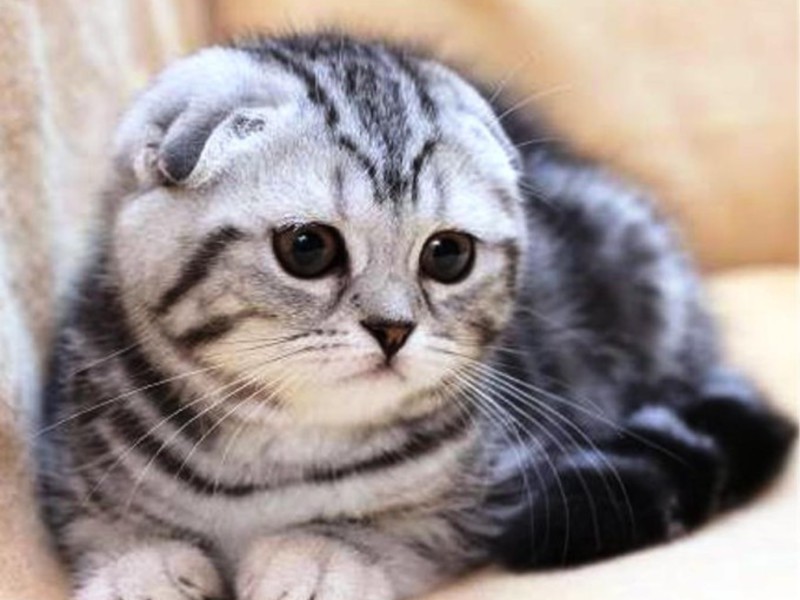
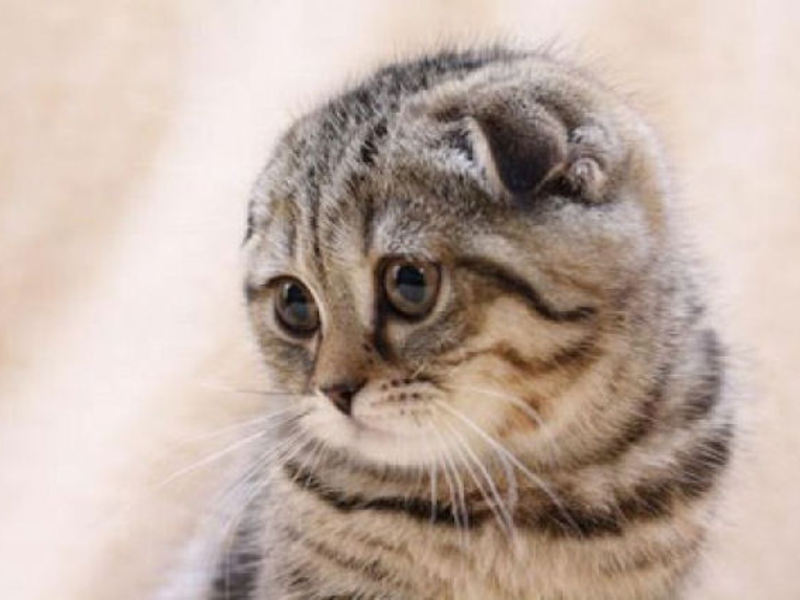
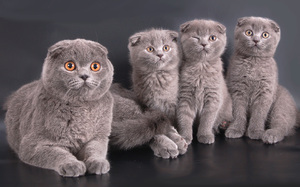 The calling card of Scottish cats is hanging earsThey are also classified according to the degree of lop-earedness.
Breeders distinguish only three:
- single degree;
- double degree;
- triple degree.
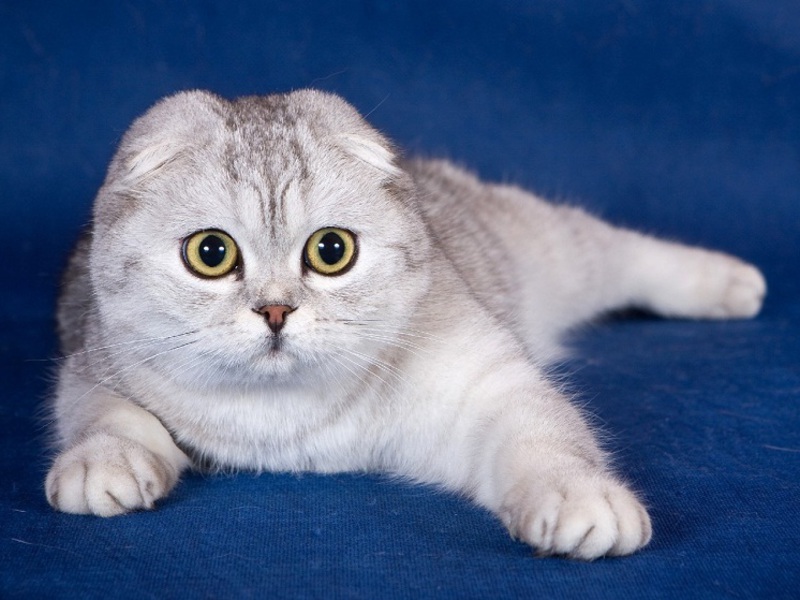
So, if only the tips of the ears are bent, then they speak of a single degree of lop-earedness. If the entire auricle is bent, but there is gap between the head and ears, this is a double degree of lop-earedness. With a triple degree, the cat's ears are pressed tightly against the head. In fact, it seems as if they are completely absent. The triple degree is the most popular.
All Scottish Fold kittens are born with straight ears. Folding begins to manifest itself around the third week of life. By the time the kitten is two months old, the breeder will be able to determine for sure whether it is a straight-eared or fold-eared kitten.
In addition to the type of ears, this breed also includes long-haired cats - Highland Folds - and short-haired cats - Scottish Folds (folded ears) and Scottish Straights (straight ears).
Possible colors of the Scottish Fold
This cat breed is famous for its huge variety of colors thanks to its rich genetic heritage. British Shorthair cat - the breed on the basis of which the Scottish ones were developed.
These cats rarely have a single color. Most often, a cat's coloring consists of two or even three patterns.
So, the most common colors:
- Solid;
- Tortoiseshell;
- Bicolor;
- Tabby;
- Marble;
- Smoky;
- Calico.
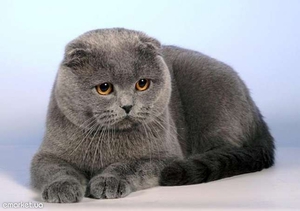
Solid coloration – a solid color – black, lilac, blue, or variations thereof. With this coloration, the animal's entire body is uniformly colored.
 The Tortie (tortie) coat combines two primary colors: black and red. The color proportions vary from cat to cat.
The Smoke coat has an interesting feature: uneven color distribution across each hair. The undercoat is usually light, while the tips of the hairs are quite dark.
Tabby pattern – the second most popular color among cats of this breed. The animal is covered with stripes and spots, which are called tabby. They are much darker than the rest of the coat. An indispensable attribute is the letter "M" of dark stripes on the forehead.
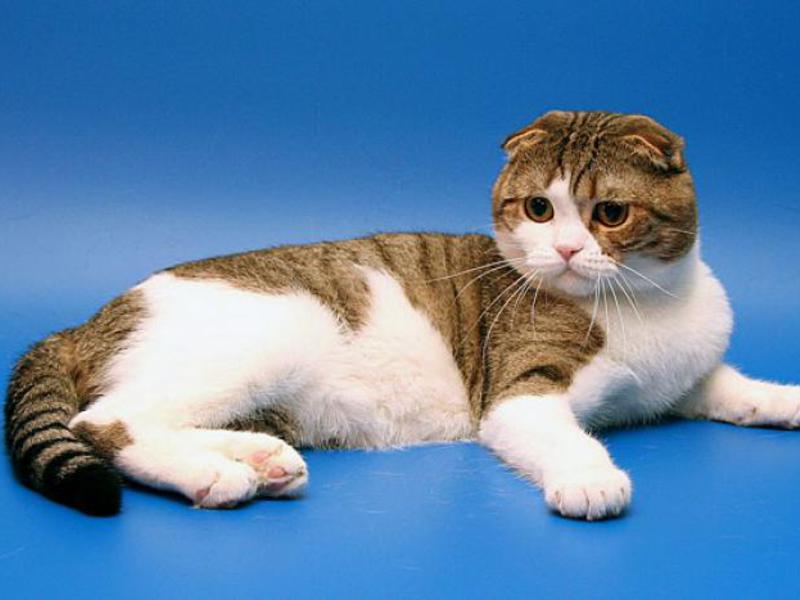
In a bicolor coat, the Scottish Fold cat has only two primary colors: one white and the other a darker shade. This shade covers the back, tail, and top of the head, while the belly, paw tips, and chin are white.
The colorpoint pattern is considered one of the most beautiful by breeders. With this pattern, the cat's paw tips, ears, and face mask are dark, while the rest of the body is light.
One of the rarest and most prized colors is calico. This color is often called the "patchwork turtle"It's found only in female cats and is essentially a combination of bicolor and tortoiseshell. That is, the cat's lower body will be white, while the upper body will be tortoiseshell. A female cat with this coloring is considered a carrier of genes for a variety of colors, making it particularly valuable for reproduction.
History of origin
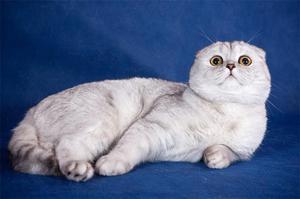 The first mentions of Scottish Fold cat They appeared around the second half of the 20th century. It was on a farm in Scotland that a kitten named Susie was born to an ordinary mongrel cat. Her ears later took on a unique shape.
However, legend has it that this was only the first fold-eared kitten in Europe, and that such cats appeared in the Far East and China much earlier than in Europe. It's worth acknowledging, however, that it wasn't until 1961 that serious breeding of cats with this ear structure began. Susie the cat's daughter – Snooks was crossed with a British cat. by another Scottish farmer, and her offspring were given to British feline breeders. A little later, Scottish Folds were exported to America, where American breeders carefully developed a new and interesting breed, long unrecognized by all cat associations.
The development of lop-earedness is attributed to a spontaneous mutation that weakens the ear cartilage, causing the ears to lie flat or point in different directions rather than standing upright.
Initially, it was believed that this ear structure in cats led to deafness, but this was disproved in the 1990s. In 1994, the breed was officially recognized by American cat associations, and later by international ones.
Character
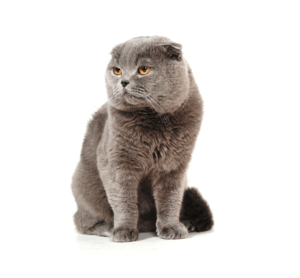 Scottish Fold cats are among those cats that are very strongly attached to their ownersThey can follow their beloved owner around the apartment, must always be nearby and will never miss her important household chores.
One of the advantages of these cats is their ability to quickly adapt to a new environment, whether it be a move, the arrival of a child in the house, or a sudden noisy party.
Scottish Fold cats are calm animals that get along well with small children and other pets. They are respectful of all family members and don't meow unnecessarily.
Young kittens are known for their playful nature, loving to frolic and make noise. But as the cat approaches three years of age, when it fully matures, its boisterous nature gives way to a rather calm one. The animal leads measured lifestyle: prefers hours of quiet rest in his favorite cat spot to fun games.
Representatives of this breed love to spend time on their owners' laps, purring and snoring contentedly. This simple way they express their love. A Scottish Fold owner will never feel lonely with a cat.
Caring for a Scottish Fold cat
Scottish fold cats don't require a lot of special care. The main requirements are a clean environment and plenty of balanced food.
Scottish Fold cat owners often have understandable questions about caring for their pet's unusual ears. But here too, everything is extremely simple: the ears need to be wipe with a special cleaning solution, which can be purchased at any veterinary pharmacy or pet store, or with boiled water and cotton swabs.
To ease shedding, experts recommend brushing your pet with a special cat brush with straight, hard bristles. Short-haired cats only need to be brushed once a week, while long-haired cats need to be brushed twice a week. Even with a scratching post, it's still best to trim a lop-eared cat's claws approximately every three weeks to a month. It's also recommended to wipe their eyes and clean their teeth with a cotton swab.
A cat should be accustomed to all hygiene procedures from an early age. It's likely that the kitten will resist at first, but if you repeat the process regularly, it will get used to it, and the reluctance will soon give way to pleasure. This is especially true for brushing.
Owners of Scottish Fold cats should remember the basic rule when breeding them: at least one animal in a pair must have straight ears, otherwise, health problems in the offspring cannot be avoided. In other words, Only a straight-eared cat will suit a lop-eared cat.
Price of a lop-eared cat
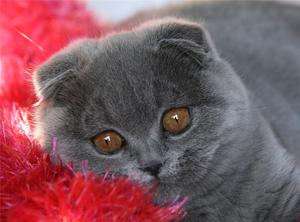 The price of a Scottish Fold cat depends directly on its pedigree, documentation, and breeder. If a kitten has at least one champion parent, it will cost significantly more than a similar kitten. The breed's immense popularity makes purchasing a kitten quite affordable for a wide range of people.
How much does such a cat cost? The minimum price set by amateur breeders is from 1000 to 1500 rublesThe average price in Russia ranges from 5,000 to 12,000 rubles. Scottish fold cats and cats from breeders will cost 15,000 rubles and up.