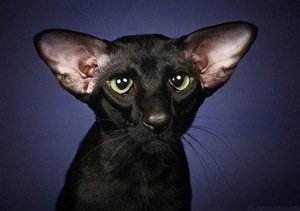
 When meeting an Oriental cat, people often have no idea what a unique, affectionate, and loyal animal this is. At first glance, the skinny cat with disproportionately long ears looks out of place, but the breed is so kind and welcoming that it will captivate any cat breeder.
In their external parameters and shapes, oriental cats are similar to their Siamese relatives, differing slightly in their fur coloring. This breed of pets gives the impression of a flexible and refined predator.However, in reality, the body structure of these four-legged apartment dwellers is very strong and muscular, as in the photo. This Oriental cat loves to play, has an excellent personality, and is even trainable, learning a few simple commands.
Content
The history of the breed
The Oriental cat possesses a unique grace, characteristic only of this breed. The Oriental's homeland is Thailand, from where the breed arrived in England in the mid-19th century, earning the respect and love of domestic cat breeders. The Encyclopedia Britannica, published in 1903, contains evidence that solid-colored specimens were among the cats imported to England from Asian countries.
The first representatives of this breed of cats appeared in the United States in 1956 and within two years they received a certain standardization. The Oriental received full recognition of the breed among American breeders in 1977.At the same time, the breed took part in a world exhibition, entering the top ten best representatives of felines in the entire world.
Today, the breed is popular with both domestic and international breeders. The Oriental cat bred by domestic catteries has acquired a harmonious appearance that has made it a strong contender at many international shows.
Features of appearance and color
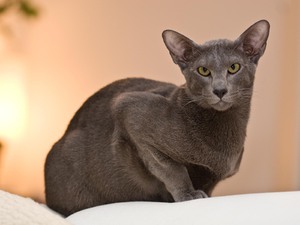 Based on the standards of oriental cats, their breed has 40 basic colors. Initially the breed developed from representatives with a uniform color – blue, brown, red, and lilac. Today, the most prized Oriental cats are those with tabby patterns—spots with stripes and marbled markings that look unique against the animal's short fur. Pets with complex patterns, such as fawn and cinnamon, are also popular.
The Oriental cat has the following distinctive external features:
- The breed has an elongated body shape as in the photo, a refined skeleton and strong muscles.
- The Oriental's muzzle is also elongated and wedge-shaped, tapering to a point. The cat has a long neck and a straight nose. The chin is medium-sized and forms a straight line at the tip.
- The animal has asymmetrically large ears, widened near the base and slightly rounded at the tips.
- She has beautiful, medium-sized eyes, set slightly slanted, with a slight slope towards the end of her nose.
- The cat's limbs are very slender, and the hind legs are higher than the front ones. The shape of the paws is oval.
- The Oriental is blessed with a long, thin tail that tapers toward the end. The fur on the tail is significantly longer than that on the cat's body.
- Shorthaired breeds have short hair that lies close to the body. Longhaired breeds have longer hair without an undercoat. Therefore, due to the close fit, the coat appears much shorter than it actually is.
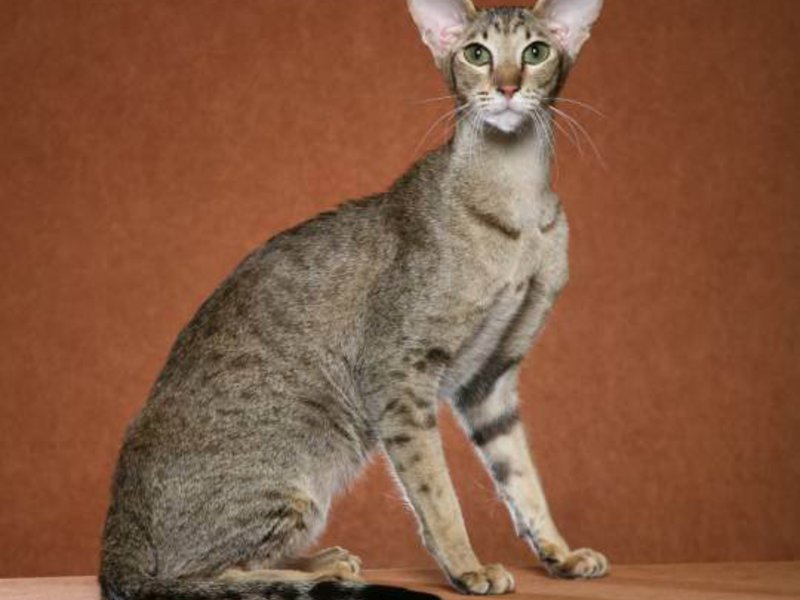
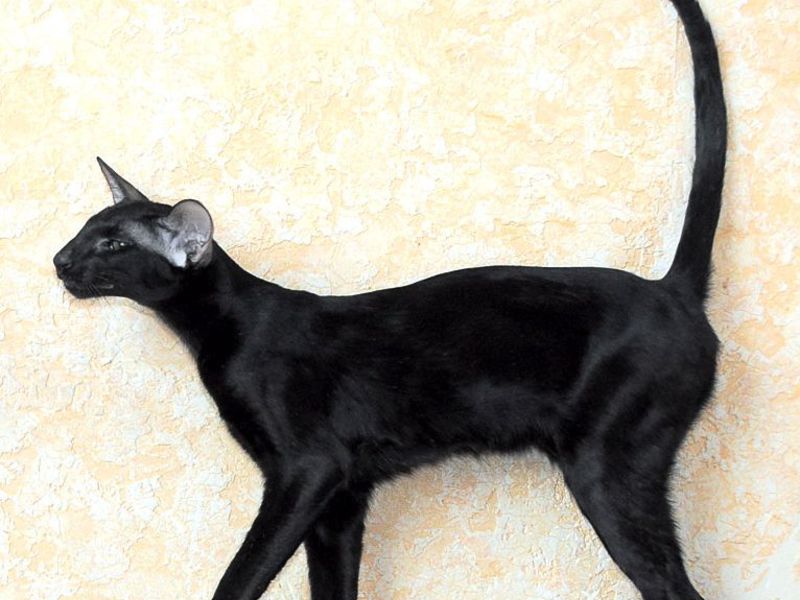
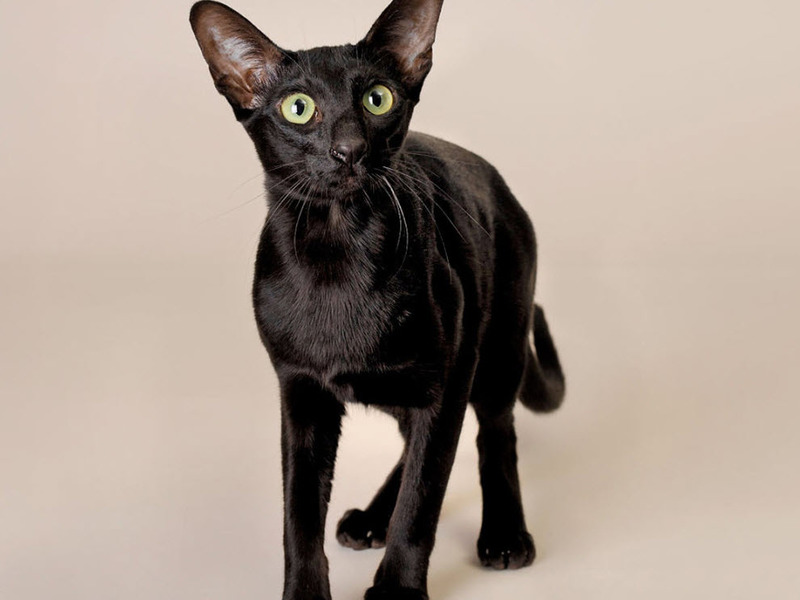
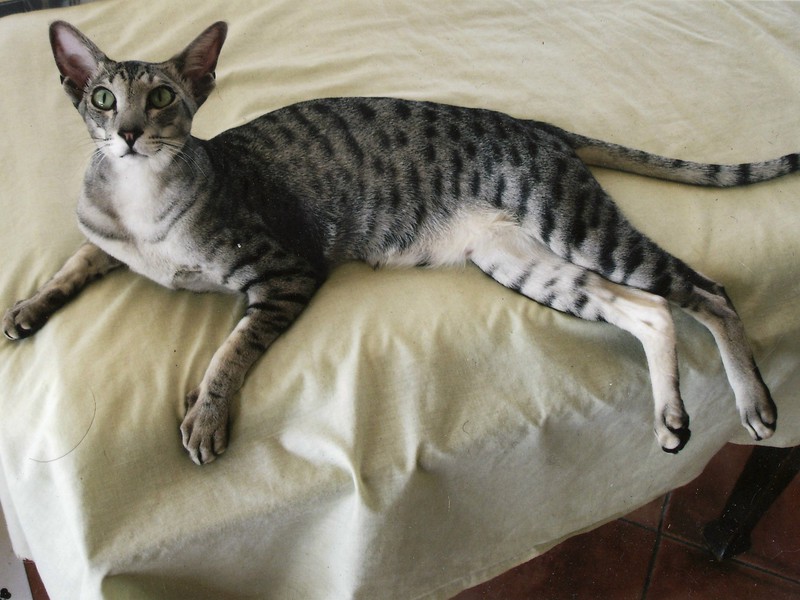
Oriental cats come in a wide variety of colors. Breeders list over 300 different color variations. In Thailand, the birthplace of the orientals Blue and copper-brown colored cats are popular. Bangkok residents love keeping Himalayan cats as pets.
Character traits of the breed
Oriental cats have three distinctive character traits: boundless love for their owner, the need for constant communication and a good appetiteThe animal needs constant interaction with people, but even when left alone, it will not meow pitifully.
Orientals have the following character traits:
 If a cat's breeder has earned the animal's trust, the cat will be devoted to its owner for life. A pet becomes so attached to its family that it can often become resentful if it isn't given enough attention.
- The Oriental cat is a breed of cat that believes the world is theirs alone and strives to attract attention by vocalizing. The Oriental cat's meow is often a favorite among humans, as it has a melodic and pleasant voice.
- This breed isn't one for independent wandering; they require constant companionship and play. Therefore, before adopting a pet, understand that it will require a significant amount of your free time. Those who prefer a more tranquil environment should consider another breed with a calmer personality.
- Oriental cats possess telepathic abilities and can detect changes in their owners' moods. As strange as it may sound, Orientals are trainable and can learn a few simple commands. However, don't expect your cat to perform acrobatic pirouettes at your owner's command.
- Surprisingly, it's easier to train an Oriental cat to go to the toilet and close the lid behind itself than to relieve itself in a litter box filled with sand. A cat can easily learn to turn on the faucet to drink water, mimicking all the actions its owner takes. It can also sense pain in humans and curl up into a ball on its own.
- The animal quickly finds common ground with small children and keeps its claws on even when engrossed in playing ball. Orientals also get along well with other pets.
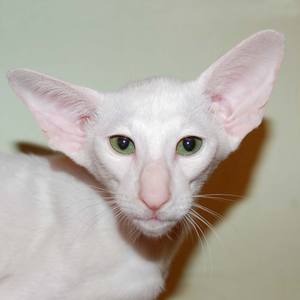 If a cat's breeder has earned the animal's trust, the cat will be devoted to its owner for life. A pet becomes so attached to its family that it can often become resentful if it isn't given enough attention.
 Surprisingly, it's easier to train an Oriental cat to go to the toilet and close the lid behind itself than to relieve itself in a litter box filled with sand. A cat can easily learn to turn on the faucet to drink water, mimicking all the actions its owner takes. It can also sense pain in humans and curl up into a ball on its own.
Despite its obvious virtues, friendliness and sociability, the animal is easily offended. This character trait was inherited from its ancestors.
How to care for orientals?
Due to the fact that this elegant animal has short hair and almost no undercoat, it practically does not shed. Oriental Shorthair cats groom themselves.Occasionally, your pet should be wiped with a special rubber glove, which removes dead skin and hair. For long-haired cats, it's recommended to brush them no more than once a week.
The Oriental is a clean animal that doesn't require frequent bathing. They don't particularly like water, which is common among all members of the feline family.Oriental hygiene mainly consists of cleaning the ears and teeth, as well as claw trimming. However, acclimating a pet to such procedures should begin in early puppyhood. To ensure a happy and active family pet, breeders must be patient and attentive when preparing for certain procedures.
- This breed is characterized by rapidly growing claws, which, once they reach a certain length, as shown in the photo, interfere with the animal's ability to move normally. Regular claw trimming is primarily necessary because pets living in apartments are unable to file them down on their own. This procedure should be performed regularly and very carefully, avoiding the special tool going past the white part of the claw.
- Orientals require regular ear cleaning to prevent the accumulation of dirt and wax. This procedure is performed with a standard cotton swab. It removes wax from an easily accessible area of the ear to avoid damaging any vital hearing organs.
- Although Orientals are renowned for their health, they can become ill without proper attention and care. Their oral cavity deserves special attention, as they are prone to gingivitis. Their mouth should be cleaned with special toothpastes several times a week.
 This breed is characterized by rapidly growing claws, which, once they reach a certain length, as shown in the photo, interfere with the animal's ability to move normally. Regular claw trimming is primarily necessary because pets living in apartments are unable to file them down on their own. This procedure should be performed regularly and very carefully, avoiding the special tool going past the white part of the claw.
Feed your four-legged family friend only from a clean bowl. After your cat eats, be sure to wash the bowl. The handsome thoroughbred is accustomed to dining in a quiet environment. and peace of mind, which must be taken into account when deciding on the location of the animal's future dining area.
It's important to remember that the Oriental doesn't tolerate being overfed. Proper nutrition is essential to ensure the animal remains slim and even slightly skinny, as is typical for the breed. Therefore, the portion of a single feeding should be small, approximately 30 g per 1 kg of weightFeed your Asian carnivore no more than twice a day. If your pet's diet consists primarily of fresh produce, it's best to give preference to raw meat and fish.
Diseases that pets are susceptible to
Despite the strength of his health, The oriental cat breed is susceptible to a number of diseases.
- Gingivitis is a disease caused by infection from tartar. It is accompanied by bad breath, excessive salivation, and a complete refusal to eat. To prevent gingivitis, it's important to regularly keep your pet's mouth clean.
- Liver amyloidosis is a disease that belongs to the category of hereditary pathologies.
- Retinal atrophy is a disease that affects animals of any age. Symptoms are subtle, and only a qualified veterinarian can detect it.
- Flat chest is a syndrome typical only for young kittens. In a mild form of the disease, a kitten may well survive and continue to develop normally.
To prevent the development of all kinds of diseases, it is important to monitor changes in your pet's behavior and regularly visit the veterinarian. need to rememberIt's common knowledge that Oriental Shorthairs don't tolerate drafts. This is because the animal lacks an undercoat to provide warmth in the cold. Therefore, they are not adapted to outdoor life in our climate. However, with proper care at home, this graceful predator can easily live for 17 years.
How to choose the right small kitten?
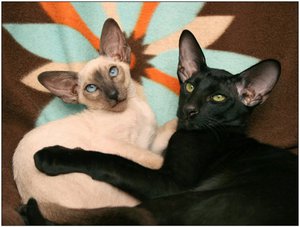 If you decide to get an Oriental, you need to understand that this isn't a cheap pleasure. Therefore, choosing an Oriental kitten requires careful consideration. The price of this good-natured predator directly depends on its color. and the presence of breeding defects. For example, a defect may include a kinked tail or other physical characteristics that prevent the cat from participating in international shows. However, this does not affect the animal's character in any way.
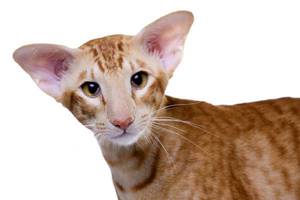
If you've decided to buy a kitten like the one pictured, you should choose one that's over 3 months old. At this age, kittens have already received their basic vaccinations and can feed themselves. When choosing a pet, pay attention to its ears—they tend to be disproportionately large in purebred cats.
It's better to buy an animal from a breeder, which can guarantee the kitten's normal development in the future. Plus, The breeder receives all accompanying documentation for the petWhen contacting a cattery, a buyer also signs a contract to purchase an Oriental Shorthair, which guarantees the seller's integrity. If the buyer has any concerns about the animal's physical condition, they can consult with the cattery owner to consult a veterinarian who can confirm the animal's health.
As you can see, this unique breed of Oriental cats, which originated in Asia, is a very friendly, beautiful, playful, and easy-to-care-for animal. When choosing a pet It is important to familiarize yourself with his pedigree and, if possible, look at photos of his parents.