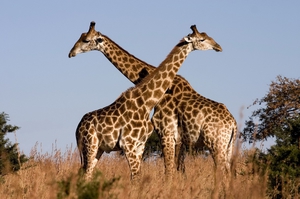
 One of the tallest land mammals is the giraffe. Close relatives of giraffes include the okapi, and distant relatives include deer. Its undeniable distinction from other animals is its extremely long neck, which accounts for almost half of its total height. Only elephants, hippos, and rhinoceroses are larger.
The appearance of a giraffe
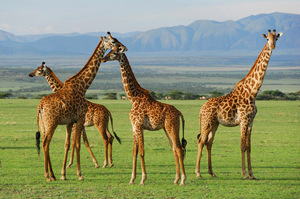 The height of a giraffe, including its neck and head, can reach about 6 metersThe average height at the withers is 3.5 meters. However, males and females differ slightly in height. Females are slightly smaller. Consequently, they cannot weigh as much as a male giraffe.
The average weight of an animal varies within two tonsThe tail is about a meter long, with a tuft of black hair at the end. Besides its remarkable height and long neck, the giraffe has another distinctive feature: its fur, covered in black and brown spots.
The spots are separated by yellowish or whitish spaces. The spots are irregularly shaped with jagged edges. However, the type of spots is the same on the body of each animal. Giraffes have stiff mane on the neckThe mane's fur is dark brown, reaching up to 12 centimeters in length.
Both sexes have a crown on the head. a pair of short and blunt hornsThey are covered with skin. However, the horns of male and female giraffes differ slightly:
- males have more massive and longer horns;
- sometimes a third horn is found on the forehead;
- The bony growths on the back of the head in old males are often well developed (“five-horned” giraffes).
Features of the neck structure
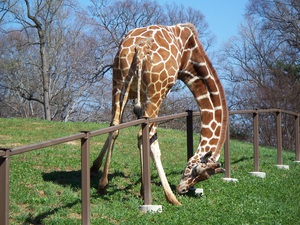 The cervical skeleton consists of only seven vertebrae. This number is typical for the neck structure of almost all mammal species. The neck is long solely due to the unique structure of the vertebrae— each vertebra is greatly elongated.
Another peculiarity is that the thoracic vertebra, the one immediately behind the cervical vertebra, is highly modified. It resembles one of the cervical vertebrae.
Blood pressureDue to their height, giraffes place enormous strain on their hearts and circulatory systems. Their hearts are well developed and strong enough to withstand record-breaking pressure.
Its values are three times higher than those in humans. This blood pressure, in turn, is necessary for blood to flow freely from the heart to the brain. When the head is raised, the pressure is located in the cranium.
Lowering the head could have created a dangerous risk of pressure buildup. To prevent the upward and downward movements of the neck from causing immediate death, nature "fuses" are provided:
- The blood is thick and has a higher density compared to human blood.
- There is a special protective mechanism, two vascular formations.
Due to these indicators blood pressure is normalizedVenous valves allow blood to flow in only one direction, toward the heart, and prevent backflow to the brain.
Maximum speed of an animal
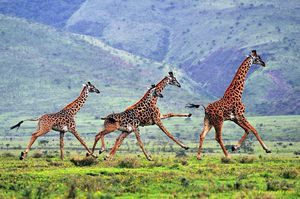 Despite the fact that giraffes are quite tall, which might seem to hinder their ability to run efficiently, they are considered very fast animals. When necessary, they can gallop. Their maximum speed can reach almost 55 km/hThis means that giraffes can outrun a horse.
However, these majestic animals often prefer to move slowly. A giraffe walks by moving one pair of hooves at a time, first to the right, then to the left. They walk exclusively on hard surfaces. This is due to their size and thin legs.
What is interesting, however, is the fact that despite its growth giraffes are capable of jumpingSometimes they are even able to overcome obstacles and barriers higher than one and a half meters.
Giraffe diet
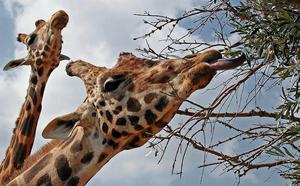 These animals are classified as herbivores, a member of the order Ruminantia. Their physiology and body structure allow them to feed on leaves from high tree canopies. Given their habitat, this allows the giraffe to remain unrivaled compared to other species.
The most delicious leaves for them are acacia leavesThe giraffe wraps its long tongue around a branch, pulls it toward its mouth, and then plucks the leaves. It pulls its head back as it does so. Despite the branches often being thorny, its mouth and tongue are not damaged in any way.
In one day, one representative of these animals is capable of consuming up to 30 kilograms of greensThis takes at least 16 hours. Sometimes, a giraffe can spend up to 20 hours doing this. Males and females have been observed eating differently. Males nibble on the topmost leaves.
They stretch their necks so far that it seems to become an extension of their neck. Females, on the other hand, don't try to reach the very tops of trees. They browse on leaves growing at body level. This is why they often maintain a bent-neck position.
Giraffes don't have a great need for water, they may not drink Nothing at all for 7 days. This requirement is more than met by the succulent feed. However, if the animal does decide to drink, the volume will be no less than 38 liters.
These animals do not really like to drink, since at this time the head will have to be lowered, so the animal remains unprotected and may not notice the impending danger.
Giraffe habitat and lifespan
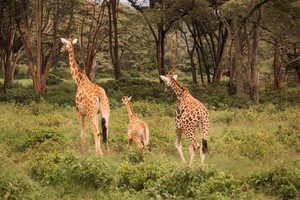 Scientists agree that the ancestors of giraffes appeared around 25 million years ago. Remains of these animals have been found in Africa and Eurasia. However, today, giraffes are found exclusively in continent Africa.
The eastern part is especially densely populated. But speaking of the southwestern part of the continent, one could say that animals there are practically exterminated. Small groups occasionally can be found in the steppesThis is due to the fact that some time ago, giraffes were hunted to extinction.
For a long time, ecologists were baffled as to how long this animal could live. However, it was discovered that in the wild, adult specimens It's rare to live more than 15 yearsHowever, a giraffe in captivity has been known to live for 28 years. This is currently the longest lifespan known to science.
So, by the end of the article, we've learned several interesting facts about giraffes, namely that they have a body height of over 5 meters, a long neck that helps them feed in a unique way, can only live in Africa today, and are capable of reaching speeds comparable to those of a good racehorse. Truly unique and interesting animals!