 The cheetah is a mammalian predator of the feline family. Researchers believe cheetahs are closely related to pumas. These animals also exhibit signs of genetic degeneration, which is why they have a high cub mortality rate.
Spreading
The largest number of cheetahs live in African countries, with very few remaining in Asia. There, isolated pockets of these wild cats remain only in central Iran. Currently, there are only a few remaining worldwide. approximately 4.5-5 thousand individuals of this species. These animals live only in open areas.
External characteristics of the species
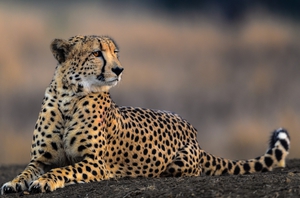
The cheetah is distinguished by its slender, muscular body. To achieve high speed, the animal has a small head and small, rounded ears. Its chest and lungs, however, accommodate a large volume of air.
Overall, the animal appears quite fragile: with a body length (excluding tail) of 115–140 centimeters, it weighs only 65 kilograms. The animal can reach a height of 90 centimeters.
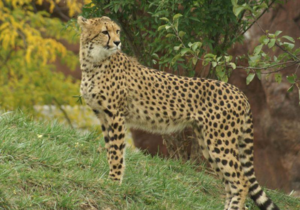
The fur is predominantly yellow-brown with small, irregular black spots. The fur on the belly is slightly lighter than on the back. The animal's face has dark stripes running from the eyes to the nose. These stripes are called "cheetah tears." They are the main distinguishing feature of the coat. There are, however, variations in skin color. For example, the so-called king cheetah, which has stripes along the backThere are known cases of animals being completely black or, conversely, light-colored without spots. Cheetahs are sometimes born with red spots rather than black ones.
The tail is particularly striking. It reaches 80 centimeters. The tip of the tail is white, and the spots on it merge into rings. The cheetah's tail acts as a balancing mechanism and a rudder.
Cheetahs have long, muscular legs. The hind legs are longer than the front legs. Their claws are only partially retractable, providing better traction when running. The soles of their paws are hard. The front legs have five toes, while the back legs have four.
Subspecies
Previously, researchers identified seven subspecies of this rare animal:
 Acinonyx jubatus jubatus
- Acinonyx jubatus raineyi
- Acinonyx jubatus ngorongorensis
- Acinonyx jubatus soemmeringii
- Acinonyx jubatus hecki
- Acinonyx jubatus radde
- Acinonyx jubatus venaticus.
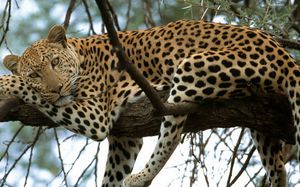 Acinonyx jubatus jubatus
However, recent studies have shown that Acinonyx jubatus raineyii and Acinonyx jubatus jubatus are genetically identical.
Moreover, cheetahs are so rare that they are listed in the Red Book as an endangered species.
Lifestyle
Nutrition and hunting
Cheetahs are diurnal carnivoresTheir diet includes meat:
- medium gazelles;
- baby wildebeests,
- hares,
- impalas.
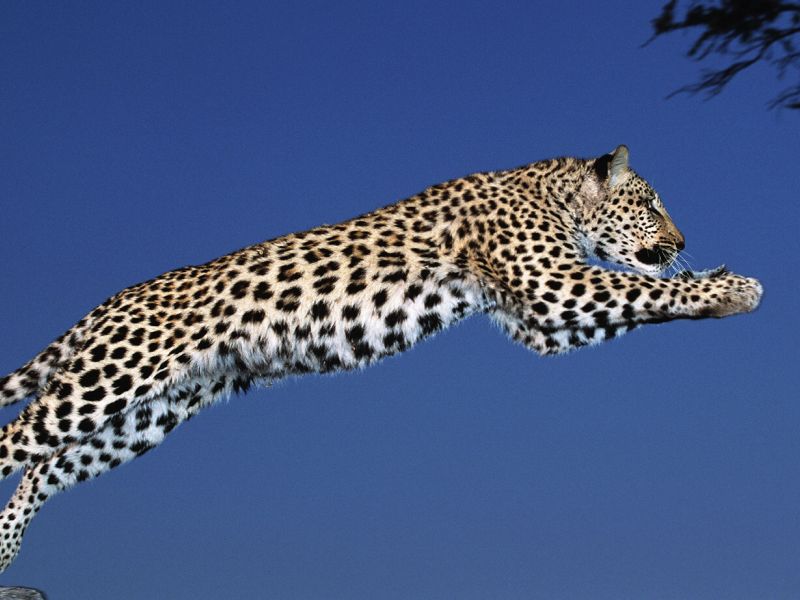
They prefer to hunt early in the morning or in the evening. Unlike other cat families, cheetahs do not ambush their prey. Since this predator lives primarily in open terrain, its primary hunting method is to chase its prey at close range. Once it has stalked its prey to within 10-15 meters, the chase begins. While hunting, cheetahs can reach speeds of up to 130 kilometers per hour. This speed is achieved in just a few seconds. Cheetahs run by leaping enormous distances of 6-8 meters. They usually knock their prey down and strangle it.
As a rule, the chase does not last more than a few secondsIf a cheetah fails to catch its prey within the first 300-400 meters, the chase is abandoned. No matter how resilient this predator's heart and lungs are, even they cannot quickly replenish the energy required to reach such high speeds.
If the hunt is successful, the animal needs to rest. During this rest, cheetahs often lose their prey to leopards, lions, and even hyenas. It's also worth noting that, unlike other predators, cheetahs don't cache food, no matter how much meat remains after the hunt. Furthermore, this feline eats only the prey it has killed itself.
Reproduction
 Male cheetahs live alone, while females and their young form packs with a stable hierarchy. The mating season lasts all year round. During the mating season, males join forces. small groups of two to three individualsTo maintain a hunting territory and the females that inhabit it. Typically, groups of two individuals can guard their territory for up to six months, while groups of three males can drive other males away from their territory for several years.
For a female to initiate ovulation, the male must pursue her for a period of time. Pregnancy in this species is relatively short—up to three months. Lambing occurs in a secluded area, typically producing 2 to 6 kittens, cared for by both parents.
Outwardly, babies are very different from adults. long gray hairKittens have a mane and a cute tuft at the end of their tail, which disappears after a few months.
The cubs are born blind, like normal kittens. After their eyes open, they begin to follow their mother, who nurses them for up to eight months. Gradually, the mother teaches the young cubs how to hunt and kill prey. Once they have learned to hunt independently, the cheetahs leave their mother. Typically, males leave in small groups, while females go alone.
The lifespan of cheetahs in the wild is on average 10-15 years, and in captivity can reach 20 years.